
My Belated Best (and Worst) Films of 2011 and 2010 Lists

So, as the title of this post suggests, this is admittedly kind of a late arrival.  This can be blamed on the fact that I was hard at work completing The Idiotmaker's Gravity Tour throughout 2010 and 2011, and missed more new films than I normally would have.  I have since made up a large portion of the difference and am now somewhat ready to present my lists of the best (and worst) films of both 2011 and 2010.

2011

2011 stands as an unusual year for me in that there was a great divide between the many ho-hum lacklusterpieces receiving acclaim and awards...and the films that were exponentially better and more worthy of the shower of praises that seemed to be inflexibly reserved for the more popular/populist work.  French import The Artist as Best Picture of 2011?  Mon Dieu!  What love potion was in the critics' and voters' cereal when they endorsed that film's check-off box?  Talk about a prescription for happy glasses!  The Artist, to me, was an admittedly charming and clever but also incredibly slight gimmick movie.  No more, no less.  Its finest and only true accomplishment: educating certain viewers as to the history of silent film.  So, with that said, I also found the rest of 2011 Academy Award nominations and winners to be a fantastic farce.  In a year that nominates Meryl Streep for the seventeenth time in her career and awards her for the third time for a functional and "workmanlike" but mediocre turn as Margaret Thatcher, but shamefully allows a star-making, gracefully tempered but emotionally naked no-holds-barred performance like Elizabeth Olsen's in Martha Marcy May Marlene squeak by with bupkus (not even a nomination), I am left with nothing but a bewildered and frustrated shrug.  Adding insult to injury is the fact that Oscar also honored the year's flat-out worst film, Extremely Loud & Incredibly Close, a verifiable piece of excrement, with a Best Picture nomination.  Something's fishy here and it ain't the chickens in the Academy voting pool.  I can only believe there were bribes concerning that stink bomb's nomination.

In terms of my own choices for the year's best, I am almost compelled to dub 2011 as "The Year of the Cinematic Tone Poem."  Mood pieces seemed to far outweigh most other independent filmmaking efforts, and I cannot say that I mind.  Mood has become paramount for me in my own work these days, and I think my favorite films of 2011 had a great deal to do with that shift.  So, as it turns out, my 10-Best list might appear more "artsy-fartsy" and hoity-toity than usual.  Truth be told, however, 2011 is a year with which I was left mostly unimpressed with the mainstream output, although it should be noted that I do believe that 2012 is the best year in film since 1993.  So anyway, let's spark it.  Whereas looking at the year en toto left me slightly disillusioned, my choice for #1 left me exhilarated and filled with hope for the future of its young director and for filmmaking itself.

1. Martha Marcy May Marlene (Sean Durkin) - U.S.A.
Pound for pound, moment for moment, everything about this film is emblazoned with the feeling that it is the most exciting, unsettling and emotionally resonant film of the year (and maybe of the last few years), and it is certainly the creme de la creme of the year's wealth of cinematic tone poems.  When any director pushes buttons as easily as Durkin does, let alone a debut feature director, it is a truly rare feat.  Considering what I have seen in this film, I will be among the first in line to see what Durkin has in store for us next.  I have recommended this film to nearly everyone I know who has asked me what worthy films have been made in the past five years.  The images (especially the underexposed and underwater ones) were often so powerfully potent and tantalizing to me that, at one point, I flashed to what I believe to be a pre-cognitive memory...and I am not exaggerating or attempting to aggrandize the film's impact.  Martha Marcy May Marlene (otherwise known as Mx4 among friends of mine) is never coy and the audience is never left out of the act of figuring out a puzzle that gradually reveals itself via a careful flashback structure, justifying the main character's unsettled psyche.  The only complaint I had, and a minor one at that, was that the characters played by Hugh Dancy and Sarah Paulson might have fit too neatly into the categorization of self-satisfied, upwardly mobile petit bourgeois shelterbugs.  I felt sometimes that this was perhaps too easy and convenient.  But the film still worked like a charm better than any other film of 2011, and if this is a harbinger of things to come for Elizabeth Olsen, we may have just seen a star get itself all born and ready to shine.  I should also recommend Durkin's partner Antonio Campos' film Afterschool (2008), which Durkin produced.

2. The Tree of Life (Terence Malick) - U.S.A.
What can I say about this film that has not already been said, and better?  For sheer scope, size and ambition, no other film in 2011 can compare to Malick's millenia-expansive tableau of life, death, family, the creation of the universe and what lies beyond.  Can you imagine trying to elevator-pitch this film?  I shudder to think.  I certainly left the theater in a euphoric blur, with a profound sense of hope for the future of the film form.  I am, however, issuing a caveat involving Terence Malick's follow-up efforts, especially his upcoming To the Wonder, the release date of which is looming.  I am not going to be as easy or as accepting of Malick's post-Tree of Life work if he continues along the path of abusing his customary and increasingly enervating formula involving an arrangement of spellbinding (but too often frustratingly oblique) images traced with fussy verbal poetics often related via whispered voice-over narration.  I personally think Malick is too talented to continue leaning on this same stylistic formula film after film.  Reports of To the Wonder's premiere at the Toronto Film Festival lead me to believe that his new opus is just business as usual for Malick.  The greatest filmmakers always knew how to step out of their comfort zones...and I seriously doubt that Malick has ever considered doing so heretofore.  The Tree of Life is a package.  It is a beautiful and well-adorned package, complete with Emmanuel Lubezki's exquisite images, but it is designed specifically to get us mere mortals mentally and emotionally floating beatifically on "the better angels of our nature".  It is the best kind of manipulation perhaps ever in the annals of film, although I could have done without the dinosaurs in The Tree of Life, which seemed functional only to cloud and mystify the proceedings more than necessary.  But, at heart, it is still masterful manipulation and, inasmuch as I focus on this idea of manipulation, Malick proves himself to be the arthouse equivalent of Spielberg.  The Tree of Life is that rare thing: an extraordinary work of art that crosses over to the mainstream.  But as we all know, a movie ain't just images, and Malick has to know that too.  All this doesn't take away from the fact that the film is still outstanding and unique among films, and far and away the best of the films actually nominated for 2011 Oscars.  An apropos wrap-up story for my write-up: When my brother recommended that my parents see the film back in Pittsburgh, they pretty much dismissed it as a sleep-inducing load of bull, and found it to have zero appeal.  Does Malick corner himself with his "high-fallutin'" method of filmmaking?  Is a film like The Tree of Life's goal to bring humankind together into a collective transcendent movie-going experience?  Should it really be as alienating to people as it clearly has throughout the world?  Who is really his audience?  Can they be identified in any systematic way?  All, I believe, are worthy questions considering what seems like Malick's original objective in making it.

3. Margaret (Kenneth Lonergan) - U.S.A.
I saw Margaret in its 187-minute extended cut and, throughout the length of a three-hour-plus character piece, I was glued to the screen.  Filmed in 2005 but not released until 2011, the film was caught up in a sticky post-production battle that echoed throughout the trades as well as the general film sphere.  Martin Scorsese and his editor Thelma Schoonmaker ultimately had a hand in the cut released to theaters.  For what it's worth, Margaret was well worth the wait.  Oh yes, the film is a mess, but all messes should look this appealing and make this much sense.  "Mess" is a term that is supposed to be understood as having a negative connotation regarding the arts.  I find it an admirable descriptor that intimates that a work strives for more than most others do, biting off more than it can chew, leaving the unchewed parts worthy of being abstract expressionist sculptures.  Overwrought metaphor, perhaps, but it is still how I feel.  We may never want to spend the afternoon with Anna Paquin's character in real life, but Lonergan effectively frames her as a figure within an expansive (and expansively urban) canvas.  Those of you who have read much of my writings are no doubt aware that I have been in a life-long love affair with New York on film, and have written several articles on the subject.  My interest starts waning around the outset of the Giuliani era (when Times Square started turning into Disneyland), with only sporadic New York films of the 90's and aughts tickling my jaded but hopeful potential for fascination.  Margaret is one of those rare films that uses New York locales in such a way that characterizes it as a film that could not have been made or shot anywhere else, at least from my perspective.  Its milieu of teenagers in a progressive public school, their selfish and career-driven parents, their natural view of divorce as the patina of normalcy, their deceivingly adult-seeming romantic entanglements, their carefree view of Manhattan as a safe place to playfully hound and distract bus drivers while behind the wheel...and then pursue the same bus driver's ruination on an oddly independent basis -- this all bespeaks a landscape that sometimes the camera outwardly favors over the human specimens on display.  Either the landscape is favored or other unrelated people in the scenery.  In a key scene, the camera begins from a wide shot and inches ever so gradually towards a restaurant booth where Paquin's character is seated with a male friend.  The audio we hear is not their conversation, but rather that of the two older women seated in the next booth.  There are oddly tantalizing choices made all over the place in this picture.  It may not completely coalesce one-hundred percent, but in some ways it does better by not merging its elements, leaving its threads not just dangling but dancing.
 
4. I Travel Because I Have To, I Come Back Because I Love You (Marcelo Gomes, Karim Ainouz) - Brazil
This is by far the most obscure on this list.  Point blank: This Brazilian "journey film" is overwhelming.  I saw it at a one-off screening at New York's Anthology Film Archives and was blown away, particularly since I had entered a foggy period of editing my own "journey film" at the time I saw it.  The person who accompanied me felt similarly positive about this small masterpiece.  Its beautiful poetic simplicity, its courage in experimentation and its haunting and alluringly melancholic mood left a definite residue behind after leaving the theater.  Find a way to see it, if you can.  Since this film is certainly the most esoteric selection on this list, I will recount some story details.  From the Anthology Film Archives program guide: The film tells the story of a geologist who is sent on a fieldtrip to an isolated region in Brazil. The goal of his survey is to assess possible routes for a water canal from the region's only major river.  For those living on the canal's direct course, it means requisitions, departure and loss.  Many of the properties through which he passes will be flooded and many of the people and families will be relocated.  As the fieldtrip progresses, it becomes clear that the lead character shares something in common with the places he visits: emptiness, a sense of abandonment, and isolation. His geological research is slowly pervaded by a sensation of groundlessness, an incessant pining for his ex-wife, and a yearning to return home. But he presses ahead, continuing the trip in the hope that the voyage can somehow transmute his feelings.

5. Green (Sophia Takal) - U.S.A.
Sophia Takal's debut feature is yet another entry in the 2011 stock of artful cinematic tone poems.  This leisurely and ominous meditation and reflection on the nature of jealousy is a film that, in the hands of another young director, could have been just another callow and stagnantly hip entree in the modest pantheon of slightly more elastic Mumblecore genre-benders that evince a certain higher degree of film literacy.  Green nobly and admirably pushes beyond (transcends?) the niche to which it would otherwise too neatly resign itself.  It achieves something rather more unique.  It is a character piece where the muted spaces and environs breathe perhaps more than its often emotionally constricted human inhabitants (especially the quietly repressed young woman well-played by Kate Lyn Sheil).  Green's few opponents have leveled the charge that Takal uses a "lazy shorthand" and thus never really gets to the bottom of the complex emotions relating to jealousy that she attempts to illustrate, depict and gently probe.  That seems to me a shortsighted response.  The film is nothing if not a snapshot, a sketch, a Polaroid, of these irrational feelings...not an x-ray.  In this much, Takal rightly refuses to impose by holding up the magnifying glass to jealousy, and not out of either fear or ease.  The film is too plaintive to be fearful, and too fluent to be easy -- and there are too many intriguing ambiguities to suggest that much of anything is "lazy".  One leaves the theater feeling edgy and, weirdly enough, almost violated.  Takal admitted with a laugh at her Q&A that a person in a previous audience suggested that the film should end with a thriller-esque murder.  While the latter suggestion is not really the least bit viable, it is almost a valid and natural reaction considering the unsettled and unsettling way the film leaves us off.  It has a deft handle on crafting audience emotional response; it is immediate without being visceral, and wisely avoids injecting the material with unnecessary dramatic vitriol.  Among other elements, a droning soundtrack turns some otherwise simple scenes on their head.  That rigid and uneasy fade-out emotion really does fester.  Overall, Green does has some minor faults, most notably the often flagrant overuse of bleached out cut-in bursts of Sheil's character's plaguing sex-fantasy, but it remains a striking and resonant study with a lion's share of organic and largely unedited long-take shots to match its naturalistic performances.  Incidentally, I also loved a character's description of Nolan's The Dark Knight as cryptofascist...because I couldn't have put it any better or more succinctly myself.  As a footnote, kudos also to Takal's and collaborator Lawrence Michael Levine's previous 2010 feature Gabi on the Roof in July, which didn't make 2010's Ten Best, but is still a work of some merit.

6. Midnight in Paris (Woody Allen) - U.S.A. / France
Midnight in Paris is the damn nicest film since Fred Astaire, Ginger Rogers and Gene Kelly hung up their dancing shoes.  And for my money, Owen Wilson is far and away the best "Woody avatar" in a not-so-illustrious line that includes Will Ferrell, Larry David, John Cusack and Jason Biggs.  As a quick aside, truth be told, I find Kenneth Branagh's Woody imitation in Celebrity kind of endearing in an enjoyably masochistic kind of way.  Midnight in Paris is ebullient and loaded with bonhomie, and you watch it somehow innately knowing that everyone working on the film, either as an actor or as a technician, is having a bona fide first-class time making the film -- even the notoriously anhedonic Woody would seem to us to be smiling behind the camera -- which only increases the enjoyment factor.  It is no doubt Woody would see this airy comic excursion as a light meal.  It certainly is one to savor.  In point of fact, it's a moveable feast.


7. Almayer's Folly (Chantal Akerman) - France / U.K. / Cambodia
Chantal Akerman is a class act in the international cinema scene.  Since her earliest essay films, especially her brilliant News from Home (1976), up to her most recent masterwork Almayer's Folly, she has continued to prove that she is one of the filmmakers still working who thinks the deepest about the medium of film, and adroitly considers how to render complex themes and ideas onscreen.  She is exceptional -- just no two ways about it.  "Liberally adapting" and updating Joseph Conrad's debut 1895 novel to the 1950's Malaysia, she has deliberately lensed the film in Cambodia.  In many ways, it reminds me of Noroit, a lesser known film by my favorite filmmaker Jacques Rivette, except that I admit Almayer's Folly is a more successful piece.  It just proves to me that my ongoing admiration for Akerman is well-founded, and I hope she keeps doing what she does.

8. Aurora (Cristi Piui) - Romania
This minimalist epic's U.S. premiere proved controversial.  Its most virulent Stateside critics argued that the 184-minute film is spartan and spare to the point of near non-existence.  They might have a point.  A few people I know who tried to watch it eventually lost their patience.  It is a simultaneously light and heavy text.  It is as if Cristi Piui was confronted with the challenge of making a narrative film as narratively minimalist as it could possibly be.  It may be minimalist, but it is never threadbare.  What makes this film sing is that its sober and deliberate camera is painstakingly subjective.  Its lack of ornament just becomes a fact of life as one gets fully immersed into the film as a result of it.  Aurora works on such a slow-burn aesthetic that you wonder not only what you have seen during the previous three hours, but also where you have been during all of it.

9. The Color Wheel (Alex Ross Perry) - U.S.A.
Ex video store clerk Alex Ross Perry is just my kind of artist.  Any filmmaker who can, as New York Times critic A.O. Scott aptly put it, "scramble my signals" is worthy of some form of praise.  In my book, a film scrambling signals is near gold-standard.  The Color Wheel, Perry's second feature, is the type of film that can take a description like "idiosyncratic" and make it seem like something to which to aspire.  Ostensibly, it is a road film (a subgenre that is admittedly a soft spot for me), but to categorize the film strictly in these terms would be to pigeonhole it.  Perry is the type of filmmaker who, on his first time out, says to himself, "I am going to make my own movie version of the notoriously unadaptable Pynchon novel Gravity's Rainbow" and winds up with a strange bird of a film like Impolex, which, sure, was not entirely successful but definitely had guts.  I am rewarding The Color Wheel for more than just guts.  Perry's sophomore effort is a marvel of ingenuity and originality, shot on 16mm black-and-white (another soft spot for me), slightly rough and ragged around the edges...making for solid nitty-gritty meat-and-potatoes down-and-dirty DIY filmmaking. 

10. Two Gates of Sleep (Alistair Banks Griffin) - U.S.A.
In the same tradition and mold as Aurora, this potent and powerful minimalist film is among the most artful "journey films" of the last few years.  First-time feature director Alistair Banks Griffin has cast Brady Corbet and David Call as two brothers who take a daring upstream trek to honor their mother's final request.  The widescreen images are gorgeous, the narrative is succinct and pointedly focused, and the performances are tempered and, eventually, quite powerful.

Runners-Up: Kinyarwanda (Alrick Brown), Shame (Steve McQueen), A Separation (Asghar Farhadi), Hugo (Martin Scorsese), Pina (Wim Wenders), Weekend (Andrew Haigh), Uncle Boonme Who Can Recall His Past Lives (Apichatpong Weerasethakul), We Need to Talk About Kevin (Lynn Ramsey), The Interrupters (Steve James), Another Earth (Mike Cahill)

Still Need to See: The Mysteries of Lisbon (Raul Ruiz)

Most Overrated Films: Drive (Nicolas Winding Refn), The Artist (Michael Hazanavicius)
I write more about Ryan Gosling and Drive below.  My main problem with The Artist is its terminal quaintness.  I appreciated what the film seemed to be saying about the perils of artistic principle, but then it eschewed its audience's intellectual engagement for forays into melodramatic manipulation, and gratuitous cute-dog shots.  Do I think The Artist deserves its major awards?  In some ways, sure, but I would stop after giving it a special prize for moxie and enterprise.  But honestly, the film is just too cute and self-conscious for me to really take it seriously as one of the year's best movies.  I do like the two lead actors though.  I mean, I definitely bought Jean Dujardin as a 1920's matinee idol all the way.  The best thing the film did was to introduce audiences to other better silent films from its native (i.e. pre-1927) era.  The film consists of pale imitations of so many silent filmmakers, and I do not see the joy in the homage that everyone else sees.  It is, in turns, a pastiche of Keaton, King Vidor, Chaplin, Lloyd and Dorothy Arzner.  But I cannot perceive the pleasure that Hazanavicius should feel when he is spotlighting these silent and early cinema icons.  The Artist also commits the unpardonable sin of lifting Bernard Herrmann's Vertigo score for almost its entire third act.  That was upsetting to me because it was a shameless steal and not a pastiche.

The Worst Films of 2011
1. Extremely Loud & Incredibly Close (Stephen Daldry) - Ahh, one of the rare films to score an F rating at the Onion AV Club, we meet again.  There is some consolation in knowing that a precious few took this one seriously.  As one critic aptly put it, "The film should have been called Extremely Labored & Incredibly Crass."  I would add the following: offensive, schmaltzy, nauseatingly calculated, soft in the head, pandering, sometimes grossly far-fetched, tragedy-milking, conscience-less, emotionally cardboard stuff-and-nonsense.  It is rare that a movie pisses me off just because of how moronic it is.  This was such a movie, because it gets made only because it expects itself to be accepted as Oscar-bait (and sadly succeeds), and hams up manufactured Hollywood emotion that dances cutesy and goo-goo-eyed down the rows of thousands of graves.  Oh yes, and get this: they hired the gallingly awful child actor Thomas Horn after seeing him as a contestant on "Kids Jeopardy".  His dubious origins are all too apparent when you catch many of his embarrassing acting moments in the movie.  Shame on those who made the film, shame on those who greenlit a script of its like, and shame on those who got it nominated for Oscars.  As Ebert put it, "You will not discover why it was thought that this story needed to be told. There must be a more plausible story to be told about a boy who lost his father on 9/11. This plot is contrivance and folderol. The mysterious key, the silent old man and the magical tambourine are the stuff of fairy tales, and the notion of a boy walking all over New York is so preposterous we're constantly aware of it as a storytelling device. The events of 9/11 have left indelible scars. They cannot be healed in such a simplistic way."  I should note, however, that Max Von Sydow's presence outclasses everything about this singularly wretched and disgusting piece of dreck.  Direction in this is handed to Stephen Daldry, who really needs to do years of penance with all due dispatch before returning to the director's chair.  "Jeopardy" indeed! "The worst film of 2011."  "What is Extremely Loud & Incredibly Close, Alex?"  Pain from an event of mass hysteria and tragedy cannot be healed by the cinematic equivalent of a Hallmark card that doesn't rhyme or cannot string a sentence together.  My oh my, it felt good getting all that out of my system!  Did you get how much I hated it?  Did ya?
2. J. Edgar (Clint Eastwood) - Et tu, Clinté?  I could not wait for this film to end.  The assumedly "progressive" Manhattan audience with whom I saw the movie could not stop laughing at those ineptly staged love scenes.  I do not blame them a bit.
3. Your Highness (David Gordon Green) - I watched about half of this when I was invited over to a friend's house for a group movie night.  I was repulsed by it.  Imagine my shock when I discovered that it had been directed by David Gordon Green.  Oh, the pain of a talent squandered!
4. Restless (Gus Van Sant) - You expect more from someone like Gus Van Sant than a weak and painfully twee "odd romance" that offers more than just a passing wink to Harold and Maude (including the unforgivably derivative feature that its main male character attends funerals as a favorite pastime).  Yes, if you have to steal, steal from the best...but as Judge Judy is fond of saying, don't pee on my leg and tell me it's raining.

The Pleasant Diversion Award: The Descendants (Alexander Payne)

Best Performances of the Year: Elizabeth Olsen (Martha Marcy May Marlene), Anna Paquin (Margaret), Jeannie Berlin (Margaret), Kirsten Dunst (Melancholia), Sarah Paulson (Martha Marcy May Marlene), John Hawkes (Martha Marcy May Marlene), Kate Lyn Sheil (Green), Jessica Chastain (The Tree of Life), Brit Marling (Another Earth), Owen Wilson (Midnight in Paris), Tilda Swinton (We Need to Talk About Kevin), Stanlislas Merhar (Almayer's Folly)

Best Cinematography: Jody Lee Lipes (Martha Marcy May Marlene)

Best Screenwriting: Sean Durkin (Martha Marcy May Marlene)

The Worst Serious Film I Didn't See: Albert Nobbs (Rodrigo Garcia) - The horror... The horror...  Did someone just one day say, "We should dress Glenn Close up as a dude and we'll sell tickets"?  Deluded.  I cannot even look at her in the film's trailer without cringing at how awkward and just plain creepy she looks.

A 2011 Fad That I Hope Dissipates: The casting of Ryan Gosling
I have had it in for Ryan Gosling's "style" for quite awhile now.  He spent most of Drive posing and looking pretty.  He spent the rest of his career posing and looking hard-boiled.  Gosling wants you to believe that he is tightly wound as an actor, with an intensity that he can only pray can equal the giants in the profession.  Everything about him, though, at least to me, is posing.  This extends beyond the way he plays roles in films, and to the role he plays off stage and screen.  Hailing from Canada, Gosling affects a faux Brooklyn accent.  When confronted on this front, he responded that it sounded cooler.  To me, this is what Gosling is largely about, especially when it comes to onscreen presence.  The man starred in four 2011 films.  One thing Oscar got right last year was not nominating him for any single one of them.  I hope casting him is a fancy that passes within the next few years.  Knowing Hollywood's perennial jones for a pretty face, I probably won't get my wish.

2010 

2010 is slightly more balanced and tempered with both independent and mainstream titles.  2011 was a great year for arthouse, but an awful one for the mainstream market.

1. Daddy Longlegs (a.k.a. Go Get Some Rosemary) (Joshua Safdie, Benny Safdie) - U.S.A.
This consummately emotional film feels so intensely personal and, I daresay, private that one cannot help but think that the filmmaker brothers behind it had no choice but to get it all out there by making it.  And yet, lo and behold, the Safdie Brothers' acclaimed roman-a-clef is not stigmatized by ever feeling like it is just a piece of therapy in film form.  Daddy Longlegs, which I first saw under its original title Go Get Some Rosemary, is richly felt filmmaking, the act of which is clearly guided by need and not by capriciousness.  You are virtually knocked back and bloody center by a fantastic blur of emotion.  After seeing it, one is left truly exhausted but undoubtedly better off for the experience.  This loud-and-proud handheld indie follows a reckless schlemeil of a divorced father (Ronald Bronstein of Frownland, named below as a runner-up) as he spends two weeks with his sons Sage and Frey.  At one point in the film, when Bronstein's two young sons awaken after being accidentally drugged, I felt myself choking up.  After more than an hour of almost shouting at the screen in protest over the onscreen father's ineptitude, I found myself celebrating with him, and developing interest and sympathy for his bracingly obnoxious character.  As the film's playfully tongue-in-cheek dedication states, "For our father, for fun as a responsibility, for the middle perspective, a lost past, lights on during the day time, lost love but still something there, excuses, the fridge full of games, small apartments and our mother."  You had me at "something there," guys.

2. The Social Network (David Fincher) - U.S.A.
Ahh, nothing like a good old-fashioned swashbuckler film!  Too much has been written about this film already and I am not going to add very much, largely because I have nothing all that new to say.  This literate follow-up to Sidney Lumet's 1976 scorcher Network could have been more timely or released at any better moment in history.  Yes, it is a lot of young dudes, all male, behind computer screens and/or phones.  Yes, the film operates in a bubble.  Yes, it has a very docudrama-esque center.  What Fincher does, however, to exercise his authorial voice is to wisely exploit these ostensible drawbacks to mold it into something like a swashbuckler film.  Not even a corporate swashbuckler film, but something even rarer: a nerd swashbuckler film.

3. The Ghost Writer (Roman Polanski) - France / U.K. / U.S.A.
First of all, no one crafts atmosphere and formal mood as well as Polanski.  Secondly, who knew Pierce Brosnan could really...act.  I mean, yeah, I always liked him as James Bond, and he always lends a solid presence in many of his other films, but The Ghost Writer marks the first time where I am actually seeing him clearly making choices as an actor and not holding himself as a movie star.  The Ghost Writer is one of the most skillful thrillers in many a year, loving detailed and packed with nuance in every scene and nearly every shot.  I originally caught the film on a 15-hour airplane ride to India and then wound up watching it again on the way home.  When I arrived home, I bought the DVD and watched it again.  Polanski's conscious decision to shoot the entirety of the film on overcast days establishes an extremely effective mood, and reminded me of how one of my favorite films of all time, Sidney J. Furie's The Ipcress File (1965), did the same.  I was joyfully intoxicated by this film, and it is certainly my favorite Polanski film to come alone in some time.  The ashen-gray beaches and the dulled, colorless skies make this film's visuals sing.  Cameo turns by Eli Wallach and Tom Wilkinson also grant welcome diversions as the onscreen mystery unfolds.

4. The King's Speech (Tom Hooper) - U.K.
As a person who grew up with a severe stutter (it used to take me over two minutes to get my name out as a kid) and retreated from the world during my teenage years as a result, The King's Speech was a watershed film for me and, yes, thousands of other people I know via organizations for people who stutter.  On that account alone, seeing this film was overpowering to me.  I cried at the climactic scene, out of sheer joy.  I too had been at such a culminating moment before regarding a speaking situation.  I may not be the most impartial judge when it comes to this film.  Colin Firth's acting awards and accolades for his role as King George VI are well-deserved.  He invested just the right amount of outward emotion, provided an ever-commanding screen presence and got the actual stutter just right.  It is a crowd-pleaser and a populist film, indeed...but a very, very smart one.

5. Greenberg (Noah Baumbach) - U.S.A.
It is hard to care very much about a fiercely misanthropic pariah like Ben Stiller's Greenberg, the type of guy who provides a biting and unforgiving running commentary on the unwitting guy in a neighboring restaurant booth whose flamboyant gestures are irking him.  It is hard to found an entire film or novel around an unlikable central figure, let alone one that is a character study.  But writer-director Noah Baumbach, writer-star Jennifer Jason Leigh and Stiller don't just make you care, but take you all the way inside such a character in a way that is never hackneyed nor even predictable.  We grow to understand and even, weirdly enough, like Greenberg, a character that most would initially find repellant and alienating.  Greenberg is the very portrait of constipation arising from youth gone to pot.  He is an unapologetic layabout who has not the foggiest clue that he definitely has an axe to grind.  To me, Greenberg proves uncontestably that Ben Stiller is a popular comic actor capable of tremendous pathos and is more capable of building character than someone like Adam Sandler, whose dramatic turn in Reign Over Me I found horribly forced and whose performance in Punch-Drunk Love was only almost-there.  Providing able support is Greta Gerwig, whose character is equally charting the waters without a compass.  Gerwig is excellent in the role of Florence, helping to make Greenberg one of the great films of 2010...and perhaps the year's best character piece.  The climactic party scene, in which the savvy Greenberg rebukes the feckless "ADD and carpal tunnel" stupor of Generation Y with a healthy slug of wicked sarcasm, is a gem.  Kudos also to Harris Savides (R.I.P.) for his arresting camerawork.
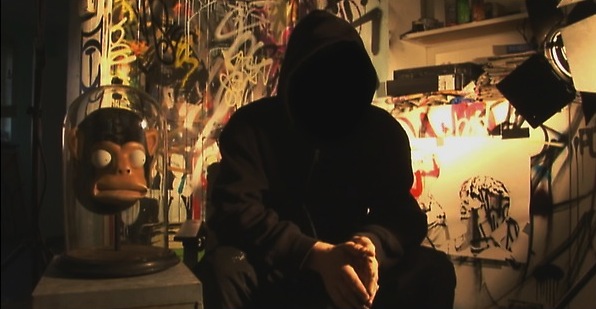
6. Exit Through the Gift Shop (Banksy) - U.S.A.
The nature of authorship is a difficult theme to make entertaining.  This (ersatz?) documentary takes more than a few unexpected turns and keeps you excited while traversing its crazy, winding road.  The Mr. Brainwash/Thierry character is both maddening and so absurdly entertaining that you find yourself pining for a six-pack, a joint and a copy of his misbegotten movie project Life Remote Control.

7. Our Beloved Month of August (Miguel Gomes) - Portugal 
The official release date of this film was 2008.  That was the Portuguese release, however.  It premiered at the San Francisco International Film Festival in 2009 and received general American theatrical release in 2010, so I am of course counting it as a 2010 film.

8. Buried (Rodrigo Cortés) - Spain / U.S.A.
Far-fetched elements aside (a cellphone that gets clear-as-a-bell reception six feet under, for one), this claustrophobic thriller kept me glued to the screen for its entire length.  It probably would have anyway, by sheer virtue of its curiosity value.  The film is filmed entirely within a buried coffin and never once leaves the confines of this constricted space.  Can such a thing sustain a 90-minute film running time?  This is most likely the first question that one asks upon first hearing this concept.  Despite the admittedly unimpressive Ryan Reynolds' occasionally labored north-of-hysteria performance and his general lack of gravitas, this remains a prodigious and impressive example of filmmaking ingenuity.  I was amazed that it kept me engaged without even once leaving the coffin space.  Something needs to be said to underscore just how impressive that is.  It gives claustrophobia a premium in entertainment value.

9. Catfish (Ariel Schulman, Yaniv Schulman, Henry Joost) - U.S.A.
Real or not real...who cares?  Honestly.  Catfish does not lean on its purported based-on-truth claim for the appraisal of its ultimate worth.  This is not the same kind of animal as the similar hoax film I'm Still HereI'm Still Here never addresses anything thematic or otherwise beyond its standard one-joke premise that is under the impression that it examines the nature of celebrity.  Catfish, on the other hand, most certainly does address a worthy theme...and also manages to entertain and compel more than I'm Still Here ever did.  It is a rich theme: Internet and identity...or rather plural, identities.  No film has tackled it as well as Catfish has.

10. Guy and Madeline on a Park Bench (Damien Chazelle) - U.S.A. (tie)
Guy and Madeline on a Park Bench is another film that affirms one's faith in the magic of cinema.  This DIY musical shot on 16mm black-and-white is a delight, and the songs are certainly catchy.

10. Barney's Version (Richard Lewis) - Canada (tie)
I have a soft spot for Canadian-Jewish author Mordecai Richler and found that the film version of Barney's Version lived up to Richler's unique literary voice.  The miniseries adaptation of Richler's St. Urbain's Horseman (2008) also lived up to this tall task, and was the first work since The Apprenticeship of Duddy Kravitz (1974) to deliver Richler's original vision to the screen intact.  I wrote about Richler slightly more in-depth in my multi-part Canadian article, with a whole chapter devoted towards Jewish Canada.  Paul Giamatti carries the torch well in bringing another of Richler's vernisht male protagonists to life. 

Runners-Up: The Town (Ben Affleck), Frownland (Ronald Bronstein), Gabi on the Roof in July (Lawrence Michael Levine), Bobby Fischer Against the World (Liz Garbus), Please Give (Nicole Holofcener), Open Five (Kentucker Audley), Cold Weather (Aaron Katz), Audrey the Trainwreck (Frank V. Ross), Leaves of Grass (Tim Blake Nelson), The Exploding Girl (Bradley Rust Gray)

Still Need to See: Carlos (Olivier Assayas), Biutiful (Alejandro Gonzales Inaritu)

Most Overrated Films: Tiny Furniture (Lena Dunham), The Black Swan (Darren Aronofsky), The Kids Are All Right (Lisa Cholodenko)
Concerning Lena Dunham, I hardly know where to even begin.  In my estimation, she has risen to become a verifiable pop culture phenomenon and a household name based on...I'm sorry, but oh so very little.  I personally believe it to be a mix of nepotism and the fickleness of the popular taste of our times.  The vision of Tiny Furniture is so limited to its posh, rich-bitch environs as to trumpet the filmmaker's all too obviously sheltered and privileged upbringing.  This is old hack, and is not a new criticism of Dunham.  There are some very good things in Tiny Furniture, her sophomore feature following her nearly unwatchable debut Creative Nonfiction (2008).  I found her obituary piece on Nora Ephron equally insufferable.  Jody Lee Lipes' elegant and effectively precise cinematography gives the film an edge over the average low-budget outing.  It is a sleek package all the way around in the visual department.  I just had an extremely difficult time caring for Dunham's overbearingly precious life in terms of her character in this film, and all of the other folks on display were equally overbearing.  There were some charming insights.  Reference to the film Christiane F. made me laugh, among other things.  But this film is just empty, empty, empty. 

The Worst Films of 2010
1. The Black Swan (Darren Aronofsky) - I seem to be among the few who saw this film for what it was: an empty and overwrought bit of nonsense.  If Aronofsky's named had been taken off it, the film would have gotten the fanfare of a pair of tit-mice in a Belgian cheese factory.
2. Holy Rollers (Kevin Asch) - Poorly researched, predictably executed, full of laughable errors and egregious oversights.  Someone should have told the director or the set dressers that Jews do not pray out of tractates of the Talmud.
3. I'm Still Here (Casey Affleck) -A tired and boring one-joke premise that does not even know how to execute its limited ambitions.  My buddies and I turned it off after 45 minutes of it going nowhere. It's rare that I leave a film unfinished.
4. Miral (Julian Schnabel) -  If you are going to tackle something as weighty and momentous as the Palestinian/Israeli conflict, you are going to have to do better than this.  A lot better.

Disappointments: Get Low (Aaron Schneider), You Will Meet a Tall Dark Stranger (Woody Allen)

Best Screenwriting: Aaron Sorkin (The Social Network) - Sorkin's screenplay gives new meaning and cojones to the term "real crackerjack scripting."

Best Cinematography: Harris Savides (Greenberg)

The Worst Film I Didn't See: How Do You Know (James L. Brooks) - Do I need to see it?  I'm sure I can tell you everything about it without seeing a frame.  How do I know?  How do I not know?  James L. Brooks, you go from Terms of Endearment to this?

The Pleasant Diversion Award: The Trotsky (Jacob Tierney) - A fun and pleasant little Rushmore-esque coming-of-age comedy from Canada.

Best Performances of the Year: Colin Firth (The King's Speech), Ronald Bronstein (Daddy Longlegs), Ben Stiller (Greenberg), Pierce Brosnan (The Ghost Writer), Jesse Eisenberg (The Social Network), Greta Gerwig (Greenberg), Michelle Williams (Blue Valentine)

A 2010 Fad That I Hope Dissipates: Dramas centered around the cyberworld
What more could a filmmaker say about the Holocaust after films like Schindler's List?  Likewise, how much more could one say about the cutthroat cyberworld beyond The Social Network and Catfish?  In other words, it has been done well, so why do it again just to do it, to pluck peoples' strings.
 

Download and View The Idiotmaker's Gravity Tour on Fandor!

As of September, my film The Idiotmaker's Gravity Tour is now available to download on the video-on-demand site Fandor.  You can access and download the film here.  It is featured on that site with many much-talked-about recent films such as Béla Tarr's The Turin Horse, Damien Chazelle's Guy and Madeline on a Park Bench, Nina Paley's Sita Sings the Blues and many others.  For the cost of a Fandor subscription, you can see my film and all these others for just $10/month (and you also have the option of a two-week free trial).  Please note that proceeds go directly back into the filmmakers' pockets.

Filmmaker Rob Nilsson, winner of the 1978 Cannes Film Festival Camera d'Or and the 1987 Sundance Film Festival Grand Jury Prize, says of the film, "The Idiotmaker's Gravity Tour is a no-budget, do-it-yourself excursion to India, from a very talented filmmaker of considerable enterprise and admirable aplomb. Actor William Cully Allen is heartbreaking in the role and has a very dynamic face -- there is a piquant, tragic quality there that makes one understand and gravitate towards him and his mission. The beautiful cinematography and the compelling story guarantee a 'gravity tour' to the East that you won’t regret taking."

In other news, I am editing to finally complete a feature-length project that I shot as far back as 2006 and 2007.  It is a stylized portrait of the short life and long death of writer Klaus Mann, son of Nobel author Thomas Mann, set in modern-day Philadelphia.  In 2007, I left behind an aborted, unfinished 62-minute cut with no ending and only half a second act cobbled together.  I returned only recently to investigate if there was enough material to finish the project.  The project is titled Sophisticated Acquaintance, which intimates that the main character is a loner, an intellectual and willfully a friend of no one.  It is also a reference to Marcel Proust's Remembrance of Things Past when the narrator refers to Swann as a "sophisticated acquaintance" and is later deprived of his mother's goodnight kiss because of Swann's presence in the family house (as the film is, among other things, about a strained familial relationship).  There were certainly some embarrassing and pretentious moments in the original cut to prove that I have grown (I hope at least) as a filmmaker in the last five or six years, and I am putting the pieces together with a new awareness of what works and what does not.  The leading pretension was the original title, Umlaut: The Klaus Mann Project.  Thus far, it's been a very fascinating process, and one that has certainly made me look back and reflect on where I was then in terms of strengths and weaknesses...and where I am now.

I am still working on Teschlock's Whale, the Rivette-inspired "reinvented recut" of The Idiotmaker's Gravity Tour in whatever spare time I have.  We will soon resume the shooting of the Sag Harbor yacht-set thriller One Corner Surfacing by first taking care of interiors in winter (although the project takes place in summer).  I will also be shooting the tentatively titled The Close Facsimile with co-director Deniz Demirer in San Francisco in January.  I am also working on a book detailing the fascinating life and career of marginalized director Sidney J. Furie (The Ipcress File, The Boys in Company C, The Entity), expanding the earlier profile piece published on this blog with the help of the man himself.  One Corner Surfacing is an homage to the work of Furie, as well as the thrillers of Alan J. Pakula and Arthur Penn.

Reinventing the Reels: Considering the Implications and Possibilities in the Rivettian Make-Over Edit

One of the countless things I admire about my favorite filmmaker and personal creative hero Jacques Rivette is his insight for recognizing and actively realizing the breadth, depth and fullness of expression in the artistic process and the filmmaking craft.  This, to me, is illustrated perhaps most in the fact that Rivette has, on his own volition, recut, overhauled and completely made over certain films of his own, as a thoughtful meditation and reconsideration of the material itself.  This is truly extraordinary, in that literally no other filmmaker on the international scene does such a thing.  This practice, however, is not to be confused with directors presenting a director’s cut and/or an extended version years after a film’s initial release.  This is reinvention.  We are talking about an artist totally rethinking the work at its core, and reconsidering its essence.  We are talking about re-focusing a project’s ambitions — watching it walk back over itself.

In 1974, Rivette recut and reinvented his Out 1 into the retitled Out 1: Spectre.  In 1981, he reshaped his feature film La pont du nord into a short film called Paris s'en va.  In 1991, he recut his La belle noiseuse into the retitled Divertimento.  These are six completely different films culled from the same wells of footage.  There are select isolated incidents in cinema history when material is used over again in only slightly reinvented versions, but no one seems to think as deeply about the ramifications of this as Rivette does.   One such example is Alain Robbe-Grillet, who helmed N. a pris les dés (1971) using footage from his previous year’s Eden and After (1970).  Robbe-Grillet later did the same in literature, reworking his early novel Le reprise into a late-career novel called Les gommes. In the music world, the late musician Arthur Russell conceived many of his most haunting cello/vocal songs using worked-over riffs, repeated, sharpened then softened again with a shuffling of moods and audio motifs. Russell meditates on these elements, in some sense reinventing them in succession over the course of entire albums.  Filmmaker Alain Resnais also toyed with a similar notion of meta-reinvention with his 1993 diptych Smoking/No Smoking.

Sure, needless to say, there are plenty of horror stories about any number of outside hands wrecking and emasculating films and, yes, I include studio heads and overzealous producers in the “outside hands” category.  But a director himself beginning again from scratch after having completed a cut he has approved for release to the public, and then releasing yet a second film for the public to consider is unique and exhilaratingly novel.  It’s a patently original process, demonstrating great care, respect and excitement for the form, as no other filmmaker in my perspective possibly could demonstrate it, at least to such an extent.

Time Out London critic and film scholar Jonathan Romney writes of Divertimento, “Rivette here remodels La belle noiseuse into another film entirely, using alternative takes, recutting to a much brisker rhythm, and bookending it with a discretely but crucially different beginning and ending.  The film makes more of a mystery out of the artist-model relationship; the emphasis now shifts radically onto the artist’s wife, who now witnesses the proceedings from outside, much as we do.  It’s a lighter film, but by no means slighter; it’s more like the difference between a Henry James short story and an extended performance piece.”  Romney also writes that Out 1: Spectre is “not so much a digest of Rivette’s legendary original Out 1 as a ghost and a reworking of some of the same material (‘a critique,’ Rivette himself says).  Cinema will never be the same, and neither will we.”  I cannot undersell how enterprising and fascinating this is.  This idea of a film critiquing itself within the outlines of a reinvention of itself is truly revolutionary, and not even Godard at his most deconstructively fiery could reach these heights.  Of this, Rivette says, “Film is not granite or stone.  It lives.  A general release of one version does nothing to change that.”

Jonathan Rosenbaum writes, "Complicating the textual status of Out 1 still further is the 255-minute Out 1: Spectre, which Rivette spent the better part of a year editing out of the original material. Part of the fascinating difference between the two films can be seen in the ways that identical footage can often carry disparate meanings and perform radically different dramatic and narrative functions according to its separate placement in each film. (The opening shot of Spectre, for instance, occurs almost three hours into the serial. One of the more striking differences in the long version is that Michel Lonsdale, the director of one of the film's two theater groups, emerges as the central character -- not only because of his role in guiding his group's improvisations and psychic self-explorations, but also because his ambiguous role as a rather infantile patriarch becomes pivotal to the overall movement of the plot.)"

As I am on hold while facing vexing but not insurmountable production troubles on the thriller I am directing, promoting my newest film A Simple Game of Catch, and in early pre-production on a film I am co-directing in San Francisco, I have decided to “do a Rivette” on my 2011 feature The Idiotmaker’s Gravity Tour.  I have taken this task upon myself knowing that there is enough material that was never used in the original version, which makes such a prospect exciting for me as its principal creator.  Insofar that every film one makes is like a child to its filmmaker father/mother, I will have eventually given birth to twins.  In considering this upcoming recut of my own film, seeing my raw material anew with a fresh pair of eyes courtesy of the sweet immunities granted by time and distance, and calling to mind how exceptional Rivette’s cinematic “reinveted films” are, I started thinking about what other films for which I would love to see make-overs — and not out of discontent for the films the way they are currently, but out of an awareness of and excitement for their own elasticity.

Not every film warrants reinvention, however, and some films warrant it more than others.  For instance, in the creatively fertile early 70’s, it seems that shooting ratios (i.e. the ratio of raw film shot to film elements used in the final cut) were at the most “insane” for American film.  It was not uncommon for filmmakers to shoot almost a million feet of film for a 90-minute motion picture.  In perhaps the most exploratory and intensely probing period for actual film production, when single scenes became encounter sessions and epic-scale improvisatory wonder-reels, and when the editing process became something akin to active sculpting of the unwieldy moving parts, the possibilities for re-toolings works of this nature are endless.

Similarly, The Idiotmaker’s Gravity Tour, a film which pays homage to many of the pictures of that period, was simply a constant discovery in that the cameras just rolled often with only the vague outline of a game-plan, ending up with a prodigiously large shooting ratio and material at which I ultimately chizzeled away for over a year.  As a result, I have one finished film and loads of unused material that I’ve been turning over in my head for some time, and I now believe I can tell another story (or at least another side of the same story) with this wealth of rushes.  The new work will be titled Teschlock’s Whale.

Below are some other films which, to me, are the most promising candidates for Rivettian re-imaginings, by sheer virtue of the nature of the projects and the rumors of their shooting ratios.

The Last Movie (1971, Directed by Dennis Hopper)  Wild stories of this film’s production are truly the stuff of legends.  Running the gamut from a dancing-wild-in-the-aisles airplane trip to Peru with cast and crew, to a drug-fueled flying-by-the-seat-of-your-pants shooting schedule, The Last Movie has time and again been used as an example of the wretched excesses of the New American Cinema of the early 70’s.  I am one of a steadily growing number of admirers, however, who find that film extraordinary, or at the very least challenging and brilliantly daring.  Albeit, this is through the lens of four decades having gone with the wind.  It is certainly one of the few examples of abstract expressionist filmmaking.  Dennis Hopper himself used the term “abstract expressionism” to describe the film’s bold editing techniques in the now rarely seen 1988 documentary Out of the Blue and Into the Black.  At the time of its original 1971 inception, though, it was barely released and promptly buried as an incomprehensible failure of the first order.  As rumor has it, cult director Alejandro Jodorowsky (of El Topo and The Holy Mountain fame) goaded Hopper to rip an early more straightforward edit apart in favor of a final version that would, among other things, more directly insure traumatizing the Universal Pictures execs.  Most of all, though, what the current edit of the film does is test the elasticity of the film form to muse on its fallibility and its beautiful fallacies.  One can witness an unhinged Hopper in Taos, New Mexico editing The Last Movie first-hand in L.M. Kit Carson’s documentary The American Dreamer, and that can tell you an awful lot about Hopper’s chaotic, tripped-out headspace while putting the film together.  A miscellaneous brigade of hippies and transients that Hopper encountered in Taos had their go at shaping the film’s final form.  However, knowing what the shooting ratio was on The Last Movie and knowing what must have gone on while on location in Peru makes one chostle in wonderment about how a Rivettian reinvention of the material would play.  Unfortunately, Hopper has left the planet, so we will most likely never know.  As is, it is a film that has angered and frustrated audiences for decades.  That does not take away from the fact that the film is still brilliant and original…even if it were only by sheer virtue of being itself loud and proud.

One-Eyed Jacks (1961, Directed by Marlon Brando)  The workprint Brando turned into Paramount Pictures in 1961 for his Method Acting Western-revenge saddle-drama was over five hours long.  At 141 minutes, the film still holds the record for the largest shooting ratio in Hollywood history, with six times the amount of footage normally shot on a picture of that size.  First-time director Marlon Brando assumed the director’s chair after personally firing Stanley Kubrick.  Cineastes have been trying to envision for years how a Kubrick-directed One-Eyed Jacks would have played.  What transpired as a result of Kubrick’s firing was a genre-constrained acting workshop for Brando and his band of undoubtedly bewildered actors.  Just how much and how substantially the film could be altered and re-focused will probably be forever left to the imagination, as the footage is most likely long deteriorated and/or destroyed.  As it is, One-Eyed Jacks would most definitely make my top-ten favorite Westerns list, and is also a favorite of Martin Scorsese, mostly because it takes a standard cowboy-bandit revenge tale and injects a healthy dose of Stanislavsky, in which we can see Brando wired at his most layered and finely tuned since On the Waterfront—and it’s a small wonder that his career petered out for over ten years after this film’s completion, as his amount of exertion on this film probably made him run out of gas fast.  One can only wonder if the mountains of unused material could yield a solid reinvented edit, but I personally have faith that there most likely was enough.  Concerning even his five-hour cut, Brando was unhappy with the final product.  Of it, he said, "It's a good picture for Paramount, but it's not the picture I made.  Now, the characters in the film are black-and-white, not gray-and-human as I planned them."

A Safe Place (1971, Directed by Henry Jaglom) According to a 1971 public television talk show featuring film critic Molly Haskell in which she interviews Peter Bogdanovich and Henry Jaglom about their respective films’ inclusion in that year’s New York Film Festival, Bogdanovich reveals that Jaglom shot enough material on his debut film, the 94-minute A Safe Place, to render at least two finished films.  Unused material apparently included a lost scene of Bogdanovich himself dancing and juggling.  Bogdanovich later says in that same talk-show interview, “I think Henry just wanted it for his scrapbook.”  In interviews decades after the aborted Columbia release of the sharply polarizing A Safe Place, Jaglom claimed that he shot around 65,000 feet of film on the project, rendering his shooting ratio somewhere in the range of 15:1.  Considering both this prodigious shooting ratio and the breezily experimental nature of the film, a hallucinatory and fragmentary journey into the world of a young woman’s complex emotional life, one can easily and with very little concerted effort imagine an alternate Rivettian reinvention of the material, and one that would zero in on other themes and aspects of Jaglom’s simultaneously loose but tightly structured tableau.  Then again, truth be told, it would also be interesting just to see Bogdanovich dance on camera.  Jaglom remembers the film's massacre in the press: "The New York Times or Time Magazine said the film looked like it had been tossed in the air and landed in a mix-master."  The film dabbles in a variety of thematic areas including memory, illusion, time and its repercussions in the world of human emotion and, in many ways, women's liberation.  The character tries to find her "safe place" by, among other things, willfully abstaining from the world at large, rather than by clawing away at her identity.  These are rather capacious thematic aspects, each worthy of their own film (or even their own recut and reinvention).  Screen tests featured on the Criterion Collection DVD of the film intimate that scenes existed between characters who, in the finished version, passed like ships in the night (e.g. the characters played by Phillip Proctor and Gwen Welles share a seduction scene in the screen tests, and never share a moment together in the final cut).  Jack Nicholson’s appearance in the final cut of the film feels deliberately capricious and fly-by-night, suggesting to me that his scenes were heavily workshopped as the cameras rolled mag after mag.   Orson Welles’ “wonder rabbi” character, the presiding spirit in Tuesday Weld’s character’s fractured cine-psyche, seems similarly urged towards in-the-moment invention by a general on-set spirit.  Evidently, Jaglom also captured a collection of encounters with various personal friends and personal acquaintances for the film, as well as recording every nook and cranny of his parents’ posh Central Park West apartment as it existed in 1970.  Now, one can most likely only imagine, and leave it at that.  As an addendum, Jaglom’s sophomore feature, the 90-minute Tracks, is perhaps equally a candidate for Rivettian reinvention, as an early version of that film allegedly ran four hours.

Scenes from a Marriage (1973, Directed by Ingmar Bergman)  It would seem as if Bergman chose to shoot Scenes from a Marriage in much the same style as Rivette shot both Out 1 and La belle noiseuse, with a copious amount of angles that could serve in visually and psychologically re-contextualizing the audience's experience of watching the tremulous marriage between Liv Ullman and Erland Josephson disintegrate, if re-edited in such a way.  Bergman's objective in making this film seems quite focused and incisive, however, and it is doubtful that he would have ever entertained a reinvented version of this film, although it was ultimately condensed from a 281-minute Swedish miniseries down to a 173-minute American theatrical film—and there is a palpable difference in the rate of an audience's appreciable emotional exhaustion between the two cuts.  Woody Allen's Husbands and Wives could similarly be re-imagined in this vein, considering its kamikaze jump-cut hand-held style.  In Episode/Chapter 5 of Scenes from a Marriage, titled "The Illiterates," the ferocious argument over the signing of the couple's divorce papers constitutes the majority of screen time.  It is a sequence whose power and message solely relies on the conviction of the actors and the precision in the rhythm of cutting, and Bergman does establish such a precision.  As much as there are different ways of painting a landscape or a face, there are a myriad of ways to cut a scene, with every bit as much precision.  Rivette's use of alternate angles in an early dinner scene of La belle noiseuse/Divertimento alone renders a different scene both psychologically and emotionally.  Scenes from a Marriage is perhaps one of the most exciting prospects for a reinvented film, but alas, it will most likely never happen.

Coming Apart (1969, Directed by Milton Moses Ginsberg) Director Ginsberg once mentioned in an interview that the cut he originally delivered to the distributor was four hours long.  As is, the film is a 110-minute series of hidden-camera encounters that psychiatrist Rip Torn has with a parade of unusual and often damaged women.  I have written about this film before, in my article about New York mayoral eras on film (despite the fact that we never leave Rip Torn's high-rise apartment over the entire length of the film).  One of the words that leaps to mind about Coming Apart is "raw" in that its edgy caught-in-real-time technical parameters and its frenzied penchant for emotional outbursts do much to jangle the nerves.  Much could be done in the editing room to render a different take on the events in the film.  This example is certainly more difficult to discuss relative to the other films I have profiled, in that it is perhaps the most confounding and discursive of the five examples.  Ginsberg certainly does not lack a sophistication in his approach, but the work itself can appear rather unforgivingly rough-and-tumble on a cursory glance.  The majority of the film is shot in long takes, and every cut is met with a harsh punch on the audio track, making us wholly cognizant of the cut itself.  I have often tried to imagine the alternate cut of the film which would function more of a scrapbook of bedlam, cutting more often than it does and often returning to fragments of the encounters that would build towards another design.  The centerpiece of the film is undoubtedly an orgiastic gathering of spaced-out individuals which occurs about an hour into the film.  Presenting this sequence alone in a kind of fragmentary manner would shape Coming Apart into something wholly other.

The Charm of Distance: A Director's Statement on A Simple Game of Catch

Years ago, back when I was a film student making wee, twee student films, my only wellspring of "Earnest Content" was that of a somewhat older female friend with whom I enjoyed nearly constant company. She was (and still is) a solid friend and I have always found her a fascinating individual. I met her when she was an instructor at my university, albeit in a department completely different from my own, and had known her for some time when she suddenly resigned from her university position, having decided to move from downtown Philadelphia to a richly secluded country-house near Doylestown. I intently observed her as she literally counted down the days until her glorious retreat from all things urban. I asked her once on camera about the nature of her eagerness to flee the city without any form of looking back. She told me, "Down here in the city, you see the best in people and you see the worst in people, but good people are preyed upon -- and really, deep down, I prefer the sound of crickets to sirens." One thing that I certainly knew deep down was that her time in the city had wounded her in many ways. She was a woman alone, at the not-so-tender mercies of a place where people are supposed to be satisfied living alone together while keeping the charm of distance from each other. It was at that time that I began to become aware of an intrinsic, systematic method many people have of pushing all strangers away. At that point in time, I conjectured that it was out of a fear of getting too close, as to irrevocably alter the perceptions one has about their reality and their environment. This fear seems to emerge from the fact that these perceptions keep you grounded with a false sense of security in a place where personal security is sometimes all you've got to rely on. I don't want all this to sound like I am down on city living. I live in a city and feel quite happy living in one. New York is a nexus of great beauty and a goldmine for artists. So, for that matter, is Philadelphia, my previous city.

Nevertheless, this female friend's dilemma in some way resurfaced in my university thesis feature A Trip to Swadades, in which a 74-year-old man returns to the city of his birth and early life, and quickly loses his way, directionless and confused in a place that he no longer knows. He also observes the city that contributed to his brother becoming a strange old hermit. The character winds up taking an only slightly more familiar tour of specific places he once knew and loved, with the guidance of a salty old friend he happens to encounter.

When I first moved to New York City, I entered into one of the most profound emotional depressions I have endured in my life heretofore. Along with a series of rather traumatic mishaps (like having my U-Haul towed the morning after I moved in, and not having a license or a lot of extra money around to pay the heavy-duty bill), I knew that I had left behind another city with friends, familiarity and established comfort, and was thrown into having to cope with existing as an even smaller speck in an even larger pond. I acclimated slightly more quickly than I would have initially predicted, and when I was enjoying a summer Friday night dinner with a new friend in a small, but lovely garden on the Upper East Side, one of her other guests started discussing the above dilemma -- that of "living alone together" with heaps and hordes of others living in compressed chambers, like two puppies in separate compartments of a pet-shop window. She was harping on how many people in mega-cities like New York often will themselves stubbornly into isolation, while the others who want to break out of it are at the mercy of those who would find the act of reaching out (and attempting to hold on) dangerous. Closeness and proximity seem to demarcate a potential for danger. I've never forgotten this conversation, and it was something I tossed around in my head for a long time. It also partly explains the film's curious title, A Simple Game of Catch. When you're a lone urban-dweller, it's hard to catch something, and even harder to hold onto something.

On that note, I later began considering what a key role my cat played in my re-emergence into the world of the living. When I moved to New York, my cat Tirzah was sick and on the verge of death, with a disease called pyometra coupled with an advanced form of upper respiratory illness. I remember very well giving her medication after medication in the cockpit of the moving van, and nursing her back to health for some months after. After going on days of aimless job searches at the height of the 2008-2009 economic crisis, I would come home and see one of the most friendly felines I've ever encountered waiting there eagerly for me. My cat Tirzah is "dog-like" in her devotion to me (I believe as a direct result of my having nursed her back to health around the time of our arrival in New York), and has always been just happy to see me whenever I turn up at home. For me, during this difficult time, it was the feeling of "Well, at least someone's receptive to me after this day of being dehumanized into a specimen for prospective employers." I was so grateful for her companionship during that period, and almost felt that she was a lucky charm in my finally nailing a job that wound up being the perfect fit.

In the film and in life, pets often assume a role beyond just that of fur-or-feather-bearing friends. They are often lifelines to those people who harbor feelings of disillusionment and those who sadly squirm at the feeling of having been disenfranchised by the sheer vastness of their concrete environs. Among the most isolated, pets are often the source of sanity. When a friend of mine in Manhattan saw an early rough cut version of A Simple Game of Catch that I screened for her months back, she claims she was haunted by the experience of having seen it for days afterwards, as she strolled down Amsterdam Avenue on the West Side witnessing dog-walker after dog-walker engaging in intimate, detailed and one-sidedly full conversations with their dogs. That's a pretty powerful thing, if you ask me, and is indicative of a larger picture of urban-dwellers longing for a companionship that even they would find dangerous if it were offered to them by someone else feeling the same. Cities tend to do that, and that's the paradox that so befuddled and amused me. So, at its most simplistic level, my newest film A Simple Game of Catch is about the deeply human connection we share with the non-human sources of warmth, love and cameraderie, i.e. pets.

On a deeper level, however, the film is about the drawbacks of the natural human need for distance. Western society and urban dwelling often takes this need to amplified extremes, particularly if we are talking about Western cities, where this distance is compounded. We might very well know that others out there, maybe even the person living next door, share our isolation, if we do indeed feel it in some form, but we are too often powerless because we are petrified of being proactive in the act of eradicating that mutually imposed distance, mostly because of what such contact might entail. In some sense, I feel that most city dwellers see it as excess baggage in the daily struggle for survival. The film actually ends with a reggae tune entitled "Happy Survival" -- this song title is treated as a tongue-in-cheek quasi-salutation. The character in the film experiences and shares with us a variety of stories of realistic but whimsical (and sometimes even transcendent) moments shared with strangers. As you might have been gathering, she is a character driven by a need to connect -- with someone, with anything, with any being, even if it's means reaching out to a person whom she hasn't seen or heard from in twenty-some years (in one of the film's most excruciating socially awkward scenes, of which there are many). Like many characters throughout literature and film, she struggles to "catch" and to hold on.

With all these thoughts and themes spinning around my head, I thought it time to explore the period of my life when I first moved to New York, and to hold a mirror up to how I felt then, and also to hold a mirror up to this fascinating human need for "over-comfortable" distance. In January 2012, just having returned from San Francisco on a business trip and having right after been saddled with the task of taking care of an imminently traveling friend's pet parrot Tango, I began conceiving the project. As I was parrot-sitting, I started immediately to notice how photogenic and entertaining the little guy was, began shooting some dry footage with him playing, eating birdseed and preening, and soon after called up Alanna Blair, an exquisite and marvelously talented young working actress with whom, at that point, I had developed a particularly strong creative rapport. I simply told her, "Hey, Alanna. Are you free the next few days? Do you want to make a movie with a parrot?" With absolutely no hesitation and an almost unbounded enthusiasm that coaxed from me a mutually enthused laugh, the two of us set sail on A Simple Game of Catch the very next day.

I told Alanna the themes I wanted to explore, the mood I wanted to evoke and emotions I wanted her to hit and stir, showing her clips from the films The Sterile Cuckoo (1969) and the more obscure T.R. Baskin (1971) as character and theme references. In T.R. Baskin, Candice Bergen’s character observes, “It’s really cruel what cities do to people. It makes them look so small.” Much like my film The Idiotmaker's Gravity Tour before it, this is a film that grew and grew steadily and organically from a lively and (in my mind) perfect collaboration. I felt free in the process of working with Alanna to build her character from the ground-up, without ever feeling rushed or under pressure to hastily act on anything at the expense of the work. It was total freedom, and a filmmaking utopia to work with an artist who was an enthusiastic about the nuts-and-bolts character development and the process of a film's creation as I always had been. I also felt more adventurous with the camera, fully exploring what would be the most interesting vantage points for every scene. As a result, A Simple Game of Catch joins the ranks of the painstakingly planned and executed A Trip to Swadades as being my most "expressionistic" film in terms of camerawork. I was also able to finally complete a long-unfinished science-fiction project that I shot in 2008 with A Simple Game of Catch, and it appears in a key sequence as the movie within the movie. One can never underestimate the thrill of putting the wrap on something that has long lain dormant.

Alanna and I took the time to workshop scenes we would formulate, rehearsing movement and blocking, and discussing performance options in a variety of ways before entering our heavily improvised scenes. Not to boast, but I defy anyone watching the movie to name which parts are improvised and which were scripted beforehand. In my mind, it is seamless. As I mentioned earlier, this project just seemed to mushroom beyond the initial vision of it as a 20-minute "sketch-pad movie." Much the way The Idiotmaker's Gravity Tour was made, I would come up with new scenes along the way, and we would shoot them when time and availability permitted, until it had become the feature-length film it now is. Editing the film proved one of the most difficult, mostly because there such a wealth of great material at which to chizzle away.

Part of the mystique about A Simple Game of Catch is that, as much as the film is about the city, it is also very much a chamber piece. After a time, the only thing to penetrate the walls of the piece’s chamber is the muffled voice of a chatty-to-herself neighbor. As the character stakes out the hallway outside the apartment, what she witnesses is an amusing crossroads of New York personalities. Sequences are comprised largely of watching the actor's emotions unfold in a very visceral sense. It is, for instance, in watching the character's post-traumatic stress stupor following a humiliating phone call. It is in watching the deep breath she takes to pull herself together following the job interview from hell. It is in watching her spazz when she wants so badly to act out in the film's climactic moment. It is in watching how her facial expression sinks when she realizes she cannot afford a couch she has agreed to buy from a hilariously peevish young dumpee. It is, for me the director of the film, watching all the amazing internal moments that Alanna Blair is able to manifest even in the littlest movements and gestures. One of the classic sentiments about acting is that is psychology manifested into behavior. Insofar as that is a performance requisite, I had an absolute blast watching every take of Alanna give it to me straight, real and true. In that much, I feel I have succeeded as the director of the film.

As the film nears completion, I'm left with the memory of what exactly I was drawn towards when I originally conceived the project. I think of the older female friend, who now lives happily and in peace on a secluded lavender farm in northern Pennsylvania where she also learns hapkido. I think of the lonely and lost character I created for my first feature A Trip to Swadades. I think of the great well of emotions I felt when I first arrived in New York as a new resident. I think of my cat Tirzah, who is still around, still faithfully sitting next to me as I edit all these films -- and to whom the film is dedicated. Yes, I dedicated a film to not just one cat, but two cats (mine and Alanna Blair's cat Preston, to whom she is likewise attached). So sue me! "My cat ain't just any cat, I tell ya!" I look at the delightful, heartfelt scenes that Alanna shares with Tango the parrot, who we grew to call the Olivier of Winged Actors (honestly, the parrot does things on camera that Slim Pickens would no doubt call "blind shit-house luck" -- either that, or perhaps the parrot was secretly trained at the Actor's Studio). Most of all, though, I look at a creative process that fostered the best out of all of those who worked on it. In the fact that, on this film, I found a creative kindred spirit in an actress who I find incredibly talented and full of promise, the "charm" of over-comfortable distance among those who live in cities is not nearly as charming and as comfortable as the simple act of creation and creative collaboration. That is something you can catch...and hold onto.

Special thanks should also be extended to Hanshi Stephen Kaufman (who appears in the film in a single scene as an actor) and his parrot Tango. Without them, there would certainly be no Simple Game of Catch.

Of Canvases and Mayonnaise: Two Tips/Requests from a Fed-Up Filmmaker in the Digital Age

Okay, this is very much me on the warpath against what I consider to be filmmaking laziness, and might seem like the ranting and raving of an obsessive film-crazy personality, but nevertheless, here I go.

1. Effectively choose the size of your canvas. Just as a painter chooses the size of a canvas for all the obvious reasons, a filmmaker must choose an aspect ratio that best reflects the needs and ambitions of the film being made. A painter does not let the canvas salesman choose his size. If a painter has a vision for what he wants to depict, but does not know the size of canvas on which he will depict it, he cannot truly proceed, can he? Just because digital camera-makers seem to support a 16x9 1.78:1 screen size across the board does not mean that you, the filmmaker, have to accept it, let alone neglect to consider it.

Also, aspect ratio should never be relagated to the dangerous equations of “intimate = standard-size” and “epic = Scope”. Part of the cinematographic art is defining a space in innovative ways. George Cukor’s A Star is Born (1954) is not an “epic” film (at least per se), but imagine that film’s signature “Man That Got Away” sequence if Cukor had not used CinemaScope. Same goes for a film like Nicholas Ray’s Bigger Than Life (1955), one of the earliest major Hollywood films about drug addiction. Those two films had no sweeping vistas of thousands marching or fighting. They were intimate stories that used complex spatial configuration to augment the psychology of the material. Altman does the same thing many of his films, using the Scope frame to depict the tableau of the social space. Part of what makes those films work so well is their use of the CinemaScope space. Likewise, it is revelatory to observe how Scorsese navigates the specially selected “smaller” 1.66:1 screen space in New York, New York (1977). Scorsese specifically did not want a 1.85:1, 2.35:1 or 1.78:1 screen-size, and he has discussed this at length on a few occasions. Also, bear in mind why Sydney Pollack chose 1.85:1 for the ostensibly epic Out of Africa (1985). Pollack has his reasons and discusses them on many occasions. Choice of aspect ratio is as much part of the process as anything else, if not more. I look down on directors working with the same aspect ratio throughout the span of a career, as it’s clear they do not give much thought to how important and how much of a storytelling tool it is. Granted, some directors’ works have never warranted a screen size larger than standard, but it should nonetheless be as much of a serious, well-deliberated consideration as the more freely and frequently discussed aspects of filmmaking like a project's intended overall look and feel. You might be shaking your head and saying, "Well, neither Aldrich nor Lumet never shot a single film in Scope. What about them? They're not 'serious filmmakers', whatever that means?" They also have their reasons and have seen or read them discussing it. Serious filmmakers think about this stuff. It seems that many digital filmmakers today have either forgotten or think it's inconsequential.

2. These days, format and process have become other key elements in the making of a film. There are as many looks for a film as there are films themselves. Choice of format should always reflect the material. That said, with the celebrated advent of the DSLR age, it seems that a lot of filmmakers now choose their format on auto-pilot, and “One size fits all” has become the default mantra. I personally applauded a friend of mine who, last year, specifically chose 30-frame standard-def for a project he directed. He chose not out of economy or convenience, but because he felt it was aesthetically apropos. Every project warrants a specific format, a different means of shooting, and an appropriate customized workflow. For instance, Lars Von Trier is a filmmaker who knows this more than perhaps anyone. Look at his choices of format on The Kingdom (from video to 16mm to 35mm), Breaking the Waves (recording a videotape edit back to 35mm) and Dancer in the Dark (cropping mini-DV for 2.35:1). If I had the money to go back and reshoot all my standard-def projects in high-definition (or reformat them to HD, if such a thing really existed), I wouldn’t do it. Those specific films were comprised for a standard-def vision. To retroactively convert it to high-definition would betray that vision.

Truth be told, I am an opponent of most DSLRs. I often make the analogy that the motion picture has lost the ultra-fine sand of film grain and has made a bid for the glossy, glazed over mayonnaise look of the DSLR. Even the more high-end cameras, like the Red, have a tendency to make every image appear overtly glossy and too pristine. However, when someone I know looked at me and my cinematographer askance when we told him that we weren’t shooting our latest feature on DSLR, I got annoyed in a rather immediate sense. My cinematographer, although frowning on this knee-jerk, seemingly epidemic response, told me later, “The DIY world is all about 'What can I use to make it happen?'.” I responded quickly by saying, “Yes, but filmmakers are cornering themselves, selling themselves and their talents short by not thinking in any form about what is right and what is best for their material. It’s now only a question of what's easy and the most fashionable, of what's the sexiest? And they get cornerned into only using what is easy and fashionable out of habit and comfort.” He certainly understood what I was saying. I continued in saying that the DIY world is filled with nearly endless possibility. But no one talks about that, because most are not interested in really mining that these days. It's simply about what's sexiest...not what's right.